Dramatic Story Telling
Serial Drama
A serial drama is a production where an entire season is based around one story, so the episodes must be watched in sequential order so the story can be understood. The whole story Arc can take up to a season or more for example Season 1 of 'The Strain' ended on a cliffhanger as the main story was not finished.
A serial drama is usually created when a writer chooses not to show the whole plot of their idea in a 2 hour long film they would prefer to spread out their idea in to episodes that can range form 30 minuets to an hour this can help properly explain a more complex plot to an audience so it has a greater effect. The story is slowly revealed to an audience over many weeks so they are not confused or get lost in lots of characters. Character development can make or break a show and it is essential to a writer that he makes sure the characters that are supposed to be liked are. A slower narrative reveal will have a much greater effect on an audience and can leave the show with a legacy take 'Breaking Bad' And 'Game Of Thrones' for example. They have both had a massive cultural impact on the modern world, their popularity is known worldwide, and 'Breaking Bad' is known to have a fantastic ending. At the beginning of some serial dramas there is a short recap that explains what has happened in the past episodes so returning audiences are brought up to speed. To get the full effect of a serial drama the audience must be grasped almost immediately or they might not pay any attention to next weeks episode this can happen through the characters it could be done through the shows writing or the visual effects or even the trailer.
Here the is the series trailer for 'Penny Dreadful' a serial created and written by John Logan, the show peaked peoples interest because of the well written characters that are all from 19th century Fiction Such as Oscar Wilde's 'Dorian Gray' and Bram Stokers 'Mina and Abraham Van Helsing' with Mary Shelly's 'Frankenstein' and Robert Louis Stevenson's 'Dr Henry Jekyll'.
The shows well written characters and haunting visual effects have both helped it gain popularity.
Soap Operas
A soap opera has many story lines within the programme that are based around the characters lives, it is mainly centered in one location and follows the characters lives, for example one of the most well known soap operas it 'Coronation Street'. It is the longest running soap opera in Britain starting in the 1960's and running into the present day. The story centers around the lives of working class people that live in Manchester. Originally created by Tony Warren the series has had well over 8000 episodes and is well into it's 17th series, there have been many episodes that stand out over the years and it is known for tugging at peoples heartstrings with the deaths of some characters with the death of the character Hayley being viewers saddest in the series, as she had been battling Pancreatic cancer the character decides to end her own life.
Most of the drama created in soaps is done through the different characters relationships and how emotionally strained they are the writer seeks to create conflict between the characters as this can resonate with the viewers watching, Conflict can be created by the writer in many different ways
say a character cheats on another character or two characters become embroiled in something illegal like a murder or a robbery. Here is an emotionally charged scene where a murder takes place you see that moment he decides to attack her and the beginning of the murder but it cuts away after that to show that she is helpless and no one knows what is happening
As there is no dominant story line in a soap there is a multitude of characters and episodes that have dealt with a multitude of themes from murder to rape. However because the writer doesn't want to confuse audiences they might make some of the issues simple for example a character cheats on another, the wronged party might be trying to deal with it but snaps and kills the character who cheated they would do this to cause interest and keep the series on it's feet so as to remain popular.
Single Drama
A single drama is different than a serial drama as it has the narrative told in one episode rather than stretching it out over multiple episodes the writer sees their idea as being able to be done in one show whether it's 30 minuets or 60. The length of the narrative does not reflect the quality of the show however. it could be a spectacular short piece and is easily told within the short span of time of the program. However it is becoming rarer to see a single drama on TV as 'one offs' are not done as much now as they used to be the most recent one off would be the 'Sherlock' episode 'The Abominable Bride' that was shown during the new Year. The episode contained many references and homages to the early 1900's which is when the original books were written and set. The idea was similar to Moffat's other series 'Doctor Who' who have regular season specials however they sometimes tie into the story
The episode contains many different expressions and quotes that didn't fit in the series that was set in the present day. These differences set it apart from the series and it's what made it as a one off that and of course the setting. It is revealed that the entire episode has just been in Sherlock's mind as he is using drugs in order to solve a mystery from the Victorian era.
Narrative Structures
Realism
Realism is a structure that is set in a way that the audience believes it to be real life and based off off real life plots and happenings. This makes the plot simpler and easier to follow as it will contain things that everyday people know about however it makes it a bit more difficult for a writer to have a character as they have to stand out to an audience, the audience needs to be able to distinguish the main character from the rest and who to support when conflicts arise. Realism contains some of the easier to do effects as it is not real to have massive shootouts and people flipping cars however it is real to have somebody beaten up on a shop corner or more horrific things like unintended murder or accidents. There is no over the top scenes in realism pieces as they use simpler things to tell the story.
There are advantages and disadvantages to realism for example the consumer is able to closely associate with whats happening on screen as something similar may of happened in their lives they will follow and associate with the characters. However a disadvantage is that plots and story can get boring in the real world so it is a writers job to keep the interesting bits of a story in so as to not fade into obscurity.
A great example of a realist piece of film is 'The Wrestler' The plot acknowledges that wrestling is scripted and shows the struggles of an aging man that tries to reconnect with his daughter and stay afloat financially.
The film deals with the story of a retired wrestler clinging onto his former glory tired of his simple life he tries to regain the popularity he once had. The film is extremely realistic with the main actor Mickey Rourke committing to the role he even re wrote a lot of his dialog because he himself was once a professional wrestler the film also included a few scenes that were real for example there is a scene in a deli and during filming real customers kept coming up to the counter so the director Darren Aronofsky told Mickey Rourke to take their orders while they kept rolling. There is also a scene during a wrestling match where Mickey Rourke's character cuts his head with a razor blade to make it seem like he is bleeding in the match. To be realistic Mickey Rourke Actually cut his head in the scenes to show he was bleeding and to add realism to the film.
Non Real
The complete opposite to realism is non realism these narratives contain things that are not possible in real life and contain lots of surreal imagery. Non real productions normally rely heavily on SFX whether CGI or not and they generally have a creative writer that has created a whole universe. However Sfx can make or break a non real film as if it looks silly then people won't like it. It has to be visually pleasing to the audience and critics.
One of the most successful genres of non realism is Science Fiction that contains some of the most loved film series, for example Star Wars.
Here the clips shows the non realism of the films in the Star Wars franchise.The creative minds behind the universe of star wars. George Lucas created a non real universe that is loved by millions with his films going down in history. No matter what you think of the prequels they are great examples of non realistic films the same as the original trilogy, with the advancement of technology the prequels do have some amazing battle scenes like the light saber duel above they also have massive armies fighting against one another.
George Lucas's Star Wars have become a stable series for non realism in film and TV the films lend their success to the quality of effects that were done to the film. The more modern films used CGI whereas the original film had to use more practical effects like mini sets and models. Take the first attack on the death star. The plot called for a massive attack on the Death star. George Lucas knew he was ambitious so he took it in his stride and they used a miniature set to film the trench run.


Linear
A linear narrative structure tells the story cohesively this is when the story is developed by each scene a linear narrative structure contains no flashbacks or flash forwards the only way different plots or events that happened in the past are revealed is through exposition dialogue. The events of the narrative happen in the present and the present only. The narratives normally introduce you to the main characters and settings at the beginning. for example the previously mentioned star wars has a linear structure with the beginning of 'A New Hope' setting out some of the characters and the threat the Empire poses.
The film opens with the struggle of the rebellion and we are introduced to some main characters The film is structured in a chronological order from the destruction of Alderaan to the destruction of the death star
Non Linear
A non linear structure is the polar opposite of linear. Linear structure unravels chronologically but non linear has a disjointed narrative structure a non chronological order one of the plot devices employed in a non linear script is the use of dream sequences or hallucination scenes. A writer would write a non linear piece if they were trying to explain or tell different stories in the same piece of film this does however require the audience to have a more mature mindset and to actually pay attention to the film. An example of a non linear film would be the 2002 art film 'Irréversible' directed and written by Gaspar Noé the film employs a reverse chronological non linear narrative that is the story about two men who seek revenge after one's girlfriend is raped. The film noted for it's extremely brutal long take rape scene and a highly graphically violent scene in a gay club caused controversy but was also praised for its non linear structure and has been associated with the New French Extremity movement. Here is the original trailer for the film
Here is what the film would be like if the scenes were in chronological order (Taken from the Wikipedia article on the film)
- A young Italian woman living in France named Alex (Monica Bellucci) is reading An Experiment with Time by John William Dunne in a park, surrounded by playing children. Beethoven's 7th Symphony is heard in the background. The camera spins around faster and faster until it blacks out into a strobe effect, accompanied by a pulsing, roaring sound. A rapidly spinning image of the cosmos can be dimly perceived. A title card reads: "Le Temps Detruit Tout" ("Time destroys everything") – a phrase uttered in the film's first scene. The film ends.
- Alex sits on the bed clothed, her hand on her belly. A poster for Stanley Kubrick's 1968 film 2001: A Space Odyssey, with the tagline "The Ultimate Trip," is above the headboard.
- Alex lies in bed with Marcus (Vincent Cassel) after having sex. Alex reveals she might be pregnant, and Marcus is pleased with the possibility. They prepare to go to a party, and Marcus leaves to buy wine. Alex takes a shower, then uses a home pregnancy test that confirms she is pregnant. She is elated.
- At a nearby Paris Métro station and aboard a subway train, Alex, Marcus, and Pierre (Albert Dupontel) are on their way to a party. They discuss sex and Pierre refers to the fact that he and Alex were once dating, but are no longer in a relationship. He implies that Marcus stole Alex from him.
- Alex, Marcus, and Pierre have arrived at the party. Alex is annoyed by Marcus's unrestrained use of drugs and alcohol and his flirtatious behavior with other women, and consequently decides to leave the party alone.
- On her way home, Alex sees a pimp called "Le Tenia" ("The Tapeworm") (Jo Prestia) beating a transsexual prostitute named Concha (Jaramillo) in a pedestrian underpass. Once the man sees Alex, he releases Concha and turns his attention to Alex, who attempts to flee, but Le Tenia catches her and threatens her with a knife. Le Tenia pins Alex to the ground and anally rapes her for several minutes of screentime, after which he brutally beats her into unconsciousness.
- Marcus and Pierre leave the party and encounter commotion on the street. Marcus wails as he discovers Alex's bloodied body being wheeled on a stretcher into an ambulance by paramedics.
- Alex is hospitalized and revealed to be comatose. Marcus and Pierre are questioned by the police. They then talk to a street thug named Mourad (Mourad Khima) and his friend Layde (Hellal). The two gangsters promise, if they get paid, to help them find the rapist, who Mourad claims is Le Tenia. Marcus and Pierre go looking for the man who raped Alex. Marcus is still high on drugs and very agitated.
- The men track down Concha, Le Tenia's last victim. At first, she refuses to talk to them. After Marcus threatens to slash her with a piece of broken glass, she identifies Le Tenia as the rapist and says he can be found at a gay BDSM nightclub called The Rectum. They are soon chased by angry sex workers seeking to defend Concha. Mourad and Layde run in a separate direction.
- Marcus and Pierre hail a taxi. Following a row, Marcus assaults the taxi driver and steals the car.
- Marcus and Pierre go to The Rectum, but do not know what Le Tenia looks like. Marcus finds Le Tenia standing with another man. Thinking the other man is Le Tenia, he assaults him, but the man wrestles Marcus to the ground, breaks Marcus's arm, and attempts to rape Marcus on the club floor. Pierre defends Marcus by grabbing a fire extinguisher and using it brutally to crush the man's skull to a pulp, thus killing him. Le Tenia – the source of all the havoc – stands there groggily, perhaps not believing he got away.
- Police arrest Pierre and put him in handcuffs. An ambulance arrives, and Marcus is put on a stretcher and taken from the club. Outside, Mourad and Layde shout homophobic insults at Pierre and Marcus. The murdered man is revealed not to be Le Tenia after all. Rather, the man standing next to him in the club was the real Le Tenia.
- Across the street in a small apartment, two men are talking about sex. One of them is "the Butcher," the protagonist of Noé's previous film, I Stand Alone. In a drunken monologue, the Butcher reveals that he was arrested for having sex with his own daughter. The subject of their discussion shifts to the commotion in the streets outside. Without looking out the window, they derisively attribute the commotion to the patrons of The Rectum. Outside, Mourad is seen talking to a police officer.
Technical Requirements
Directors need to work closely with lighting, sound and editing when making a film, a film can only be effective if these departments work together.
Lighting
Lighting can be used to effectively create a mood in the film and give a feeling of the film. Lighting can be used from a high or a low point this can create meaning in a scene and is helped by the dialogue or events. similarly if a film has a dark mood to it then a scene might not include much light in scenes they do this to outline the dark undertones the film has it is also very effective from a directors viewpoint in telling the story. Also if the film has a light tone to it then scenes will be well lit to emphasize the lighter undertones. You can use a reflector that will increase the amount of light that is being cast upon a subject.

(A reflector being used to cast light onto a subject)
Lighting can be an effective directors tool in highlighting a certain object or person so it takes the audiences attention this can be seen especially in video that contain a performance like a music video.
There is something called three point lighting it involves three lights and it an industry standard way of lighting a scene.
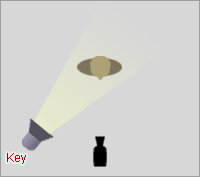
This is the 'key light' and is the main light and has the most influence on the scene it is always placed on one side of the camera/subject so the side is well lit
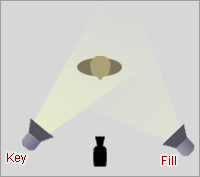
This is the 'Fill light' it is placed on the opposite side of the key light and it is used to fill the shadows created by the key light it will be a softer and lower light compared to the key light

Sound
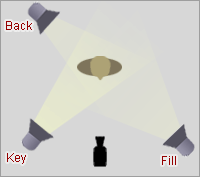
Finally this is the 'back light' and it is placed behind the subject in front of camera and lights from behind it provides subtle highlights to the subject and helps separate them from the background.
If there was a fourth light then it would be used to light the entire background of the scene
Sound
.
There is two types of sound in single camera: Diegetic and Non-Diegtic
Diegtic sound's source is visible on screen say a character comes through a door, the door would make a sound when it is opened and closed or a character speaks or sound that is coming from an onscreen instrument another term for Diegtic sound would be actual sound this doesn't include the score that would be non diegetic sound. We should be hearing everything the characters hear there is also a difference on off screen and on screen diegetic sound.
Here is a video on Diegtic and Non- Diegtic sound.
Non Diegetic sound is sound that the characters can't hear things such as narration or the score, non diegetic is added in post whereas diegetic happens during the shoot.The most overuse of non diegetic sound is done in horror films they will add suspenseful music before a jump scare tries to scare the audience. the idea that the eerie music will instill fear into today's audiences is foolish as most people now see them coming. Sound can be an important feature when ramping up the pace in a sequence for example the Church scene in Kingsman is a great example of non diegetic sound improving a film:
The scene in question already has some amazing choreography but the use of the song 'Free Bird' almost completes it and makes sure it sticks around in people's minds as an amazing piece of film
Editing
Editing can be key in telling a story I will look at the work of:

Editing
Editing can be key in telling a story I will look at the work of:
Edgar Wright
Edgar wright has become renowned for his fast cuts and amping up the pace of a scene that would usually be boring. Known for his master of visual comedy and has been very involved in the editing of his films here is a video that describes how and what Edgar Wright does.
The technical skills edgar wright employs his three cut sequence and how he uses picture and sound in his editing with things like matching scene transitions and how things exit and enter the frame.
Here is a video on edgar wright and how he does visual comedy and his editing.
Here is a video on edgar wright and how he does visual comedy and his editing.
Wright uses montages to tell a story and as a aide in telling the story. this is prominent in the 'World's End' Scene where Andy orders a water instead of a pint much to Gary's dismay.
Wright's style can be seen here most prominently about as much as a scene in 'Hot Fuzz' when the character Nicholas Angel is arming himself with many weapons the fast paced action cuts make the scene quicker and more interesting than what it would be normally (as seen in the mini documentary on edgar wright above this at 2:01.) These 'Time condensing' cuts have become Wright's trademark.

No comments:
Post a Comment